

Telesales Course
Course Aim
This 1-Day Telesales Training Course is designed to help you generate more leads, set up more appointments, and make more sales over the telephone.
You will learn the essential telephone selling skills needed to feel comfortable with cold calls and develop the techniques and strategies for lead generation and selling over the telephone.
The course is formally endorsed by the Institute of Sales Management (ISM) and is CPD Certified.
After attending, you will receive the “Telephone Sales Professional” certificate from the ISM and a CPD Certificate at no extra cost.
You can attend this course along with others from different businesses or if there are a number of you, we can run this course as an in-house version and tweak anything that you need.


Want to know more?
Please speak to one of our team or use
our online form to make an enquiry
Course Objectives
- Learn what a great job looks like
- Learn the most effective outbound telephone sales calling model
- Learn how to identify the specific needs of your client and how to match these with what you are selling/offering
- Learn high impact opening statements
- Learn phrases and one-liners to progress the sale
- Learn how to avoid those dreaded silences if things are not going your way
- Learn how to respond to objections and excuses
- Learn how to ask for the appointment or the sale
- Enhance your questioning and listening skills
- Learn closing techniques of how to get to that “YES” and close the sale
- How to get your point across without the waffle
- Learn how to build effortless rapport with your prospects
Target Audience & Who Will Benefit
- Telesales staff
- Telemarketing staff
- Incoming call handlers
- Outbound sales staff
- Business development managers
- Salespeople who have had no formal training on the subject before
- Salespeople who need a refresher and need to get “back to basics” and refocus their time and effort
- New salespeople
- Client relationship managers
- Account managers
- Commercial managers
Course Overview
Introduction & Objectives
Understanding The Telephone Sales Process
- Learn the different stages of the telephone sales cycle and how to set appointments or make sales over the phone.
- Understand what influences a decision and how prospects process decisions while on the phone.
Openings With Impact
- Discover how to open your calls for maximum impact and control the call.
- Learn how to get through the gatekeeper and to the decision maker.
- Learn how to plan and prepare for your calls and take your conversation to the next stage.
Understanding Your Prospect’s Needs
- Learn how to step into your client’s shoes and see the situation from their position.
- Adapt your approach based on what your client wants and position yourself, your company, and your product accordingly.
Telephone Responses & Statements/Phrases To Use
- Discover actual words, sentences, terminology, and phrases to use during your calls.
- Learn how to respond to common objections such as “I haven’t got the time” and “We don’t have the budget.”
Getting To The Close & Asking For The Business
- Learn strategies for identifying buying signals, knowing when the right time is to close, and how to close more prospects.
- Develop a range of cold calling tips and examples to improve your results.
Close & Actions
- Summarise what you’ve learned and plan your actions for applying your new skills and strategies to your telesales approach.
Testimonials & Reviews From Previous Attendees

(Feedback from our last 10 courses)
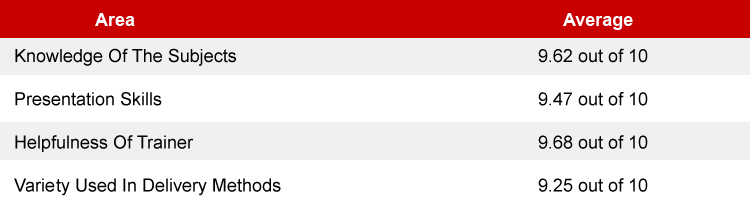
The course was delivered in an informal way that made all who attended feel very comfortable. The trainer was highly attentive and instilled confidence in the delegates by her “human” approach. I never felt awkward asking questions. I thoroughly enjoyed the course and hoping to go on another one soon.

Your trainer was excellent. He was engaging throughout the whole day and his knowledge really showed. He was able to help and give advice on dealing with different situations in my company specifically which made it very personal and I felt as though he was very passionate about delivering the course and helping us get the most out of it.

Experienced Sales Trainers
Our trainers have had years of experience both as salespeople and as trainers.
Meet a few of them to give you a feel of what they’re all about.

Trainer
Helen has over 20 years experience. She has worked with clients like the NHS, Age UK, and Thorntons. Her engaging style, fuelled by a CIPD Certificate in L&D, makes her ideal for transformative sales training.

Trainer
Bronwyn, with a decade in sales training, combines her New Insights Certified Coach expertise across finance to marketing, impacting firms like the Ministry of Commerce and CMR UK Ltd. Her dynamic approach inspires sales excellence.

Trainer
Suk’s passion for sales development shines through his 10 years in the industry and ongoing CIPD Level 5 L&D studies. His commitment to nurturing sales talent at all levels is evident in his impactful training sessions.
Course Methods & On-Going Support
We believe that training should be practical and fun. That’s why this course is delivered in an engaging way with lots of participation. All delegates receive a pre-course questionnaire to complete so we can gauge the experience and roles of those attending so we can cater for your specific needs and requirements.
After we have delivered this course, we do not just shake hands and take your money. We like to offer you some ongoing support.
Included within the cost are the following unique support options that are available to you.

FAQs about Telesales Training
How Can I Improve My Telesales Skills?
Improving your telesales skills starts with preparation, communication, and consistency.
Most modern sales roles involve phone-based selling, so how you come across on a call directly shapes how customers perceive your company. To improve, focus on your verbal communication, how you build trust, and how well you prepare for each call. Plan your telesales calls as carefully as face-to-face meetings, knowing who you’re speaking to, what questions to ask, and what information you need. Follow up after each call, schedule future conversations, and keep the momentum going. Our Sales Training course helps you evaluate your approach and develop advanced telephone sales techniques to improve conversion rates.
What Are the Top Tips for Telesales Success?
Effective telesales combines structure, empathy, and resilience.
Selling on the phone can be challenging because you rely entirely on voice and tone to create rapport. Focus on key habits such as knowing your numbers, planning your calls, and creating a warm, engaging approach. Build trust early, use a clear structure for handling objections, and always ask strong, open questions that generate interest. Remember, success in telesales is about persistence and practice. Not every call will end in a sale, so treat each one as a chance to refine your skills and strengthen your confidence.
What Skills Do You Need for Telesales?
Successful telesales relies on a mix of communication, persuasion, and listening skills.
Core skills include strong verbal communication, questioning, active listening, and the ability to build trust quickly over the phone. You also need solid product knowledge, confidence in handling objections, and clear appointment-setting techniques. A consistent call structure helps ensure every customer experiences the same high standard of professionalism. Developing these skills enables you to sound confident, handle resistance naturally, and close calls more effectively.
Do Your Telesales Courses Cover Appointment Setting?
Yes, appointment setting is a core part of our telesales training.
Whether you handle inbound or outbound calls, securing appointments is a vital skill for any sales professional. Our telesales training shows you how to plan questions that lead the conversation naturally towards a meeting, build value early in the call, and handle common objections with ease. You’ll learn specific phrases and techniques to confidently gain commitment and book appointments that convert into opportunities.
Related Courses
Our most popular venues are London, Manchester, and Coventry.
Want to know more?
Please speak to one of our team or click on
make an enquiry to submit your requirements
